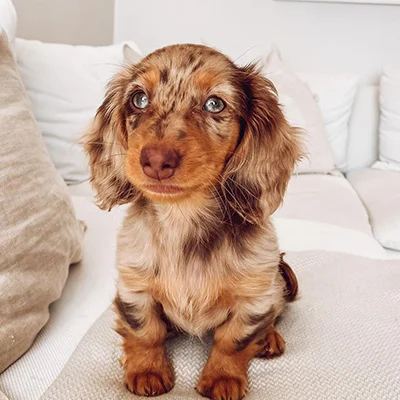
Teaching Your Dachshund Sit & Stay
Be pleasant, loving, and positive. Use treats, praise, and patience. Dachshunds respond best to reward-based training with gentle guidance — never force or frustration.
The Most Important Goal
Every obedience command comes back to one thing: getting your dachshund to calm itself and wait for your direction. A dog that can settle and look to you for guidance is a dog that can handle any situation. Sit and stay are the foundation of this self-control, and everything else builds on top of them.
Teaching Sit
- Hold a small treat just above your dachshund's nose, close enough to smell but not snatch.
- Slowly move the treat backward over their head. As their nose goes up to follow the treat, their rear naturally drops to the ground.
- The instant their bottom touches the floor, say "yes!" with enthusiasm and give the treat immediately.
- Repeat 5–10 times per session, with 2–3 short sessions throughout the day.
- Once your puppy is sitting reliably with the lure, start saying "sit" just before the lure motion. Soon the word alone will be enough.
Teaching Stay
- Ask your dachshund to sit. Once sitting, hold your palm out and say "stay" in a calm, clear voice.
- Wait just 1 second, then say "yes!" and reward. That's it for the first few tries — keep it incredibly short.
- Gradually increase the duration: 2 seconds, then 5, then 10, then 20, then 30 seconds before rewarding.
- If your puppy breaks the stay, calmly reset them back to the sit position without frustration. Go back to a shorter duration and build up again.
- Once your dachshund can hold a 30-second stay reliably, begin adding distance — take one step back, then return and reward.
Teaching Down
- Start with your dachshund in a sit position.
- Hold a treat at their nose, then slowly lower it straight down to the floor between their front paws.
- As they follow the treat down, their body will fold into a down position. The instant their belly touches the ground, say "yes!" and reward.
- If they stand up instead of lying down, try luring the treat slightly toward you along the floor to encourage the down.
- Practice in short sessions, and add the verbal cue "down" once they understand the motion.
Timing Is Everything
The moment you mark and reward matters more than anything else. If you reward during excited, wild behavior, you're teaching your dachshund that excitement is what earns treats. Wait for calm, settled behavior, then reward. Your "yes!" should come at the exact instant the desired behavior happens — not a second before, not two seconds after.
Dachshund-Specific Tips
Keep Sessions Short
Five minutes maximum. Dachshunds bore easily and a bored dachshund stops learning. End every session on a success, even if it's a simple one.
Use High-Value Treats
Dachshunds are food-motivated, which is your greatest training advantage. Use small, soft, smelly treats that they can eat quickly without breaking focus.
Train Before Meals
A slightly hungry dachshund is a motivated dachshund. Schedule training sessions just before mealtimes for maximum focus and enthusiasm.
Low Distractions First
Start training in a quiet room with no other people, pets, or distractions. Only add complexity once the basics are solid in the easy environment.